WHY CICADAS WOULD MAKE AMAZING WEBSITES

The idea that mathematics serves as a human language to describe the human experience seems very likely; we are the ones who create notation, express arguments, and convert caffeine into theorems. At the start of my undergraduate journey, I believed mathematical axioms could be chosen arbitrarily, that one could invent new mathematics from thin air. As I matured both mathematically and as a human, I was slowly coming to terms with these mathematical objects, axioms, being constructed to map reality. For example, groups encode symmetries of physical objects, and there are axioms describing what a group is. One can easily want to change the axioms and come up with a different notion altogether, but the question becomes, do we see it? Do we see it in the real world, or does it match well in other mathematical contexts?
This realization led me to choose an unusual topic for my seven-minute symposium talk at Continuum, after watching a bunch of YouTube videos, Reddit posts, and internet blogs about the connection between cicadas, prime numbers, and web design. What began as a curiosity about why certain insects emerge on 13 or 17-year cycles evolved into how the same principles appear across biology, cryptography, and visual design.
WHAT ARE CICADAS?
Cicadas are insects from the superfamily Cicadoidea, in the order Hemiptera, suborder Auchenorrhyncha, alongside smaller jumping bugs like leafhoppers and froghoppers. While they might look alien (admittedly, somewhat off-putting), the periodic cicadas found in North America exhibit a cool mathematical strategy.
These periodical cicadas spend most of their lives underground, feeding on plant roots. They emerge en masse every 13 or 17 years to mate, reproduce, and die. These are among the longest insect life cycles known to science. But the question that demands an answer is: why these specific, prime-number intervals?
THE PRIME (NUMBER) ADVANTAGE
Predator populations typically peak in composite or smaller prime cycles, every 3, 5, or 6 years, typically synchronized with other, more abundant prey. By emerging on prime-number schedules, cicadas minimize overlap with predator population peaks.
Consider a predator species with a 7-year population cycle. The least common multiple of 13 and 7 is 91 years; for a 17-year cicada and the same predator, it's 119 years. This means a cicada brood and its predators will only coincide at their peak abundances once per century or more. The same principle prevents cross-breeding between 13-year and 17-year varieties, maintaining genetic integrity across broods.
Cicadas have, through millions of years of natural selection, discovered what mathematicians formalize through number theory: prime numbers create maximally non-repeating patterns.
KEY PROPERTIES OF PRIME PERIODICITY
The cicada strategy exhibits three crucial properties:
Very long global repetition time: The overall pattern repeats only after immense intervals, typically by the product of prime numbers.
Locally irregular, almost random behavior: At any given moment, the pattern appears unpredictable, though this may be difficult to “show” as such in cicadas, but it is very apparent when we move to the next examples.
Minimal synchronization with other cycles: Prime periods ensure minimal alignment with composite-numbered patterns.
These same properties turn out to be highly desirable not just in evolutionary biology, but in visual design, pseudorandom number generation, and cryptography.
HOW WEB DESIGNERS DISCOVERED THE CICADA PRINCIPLE
Example 1: Prime Tiling
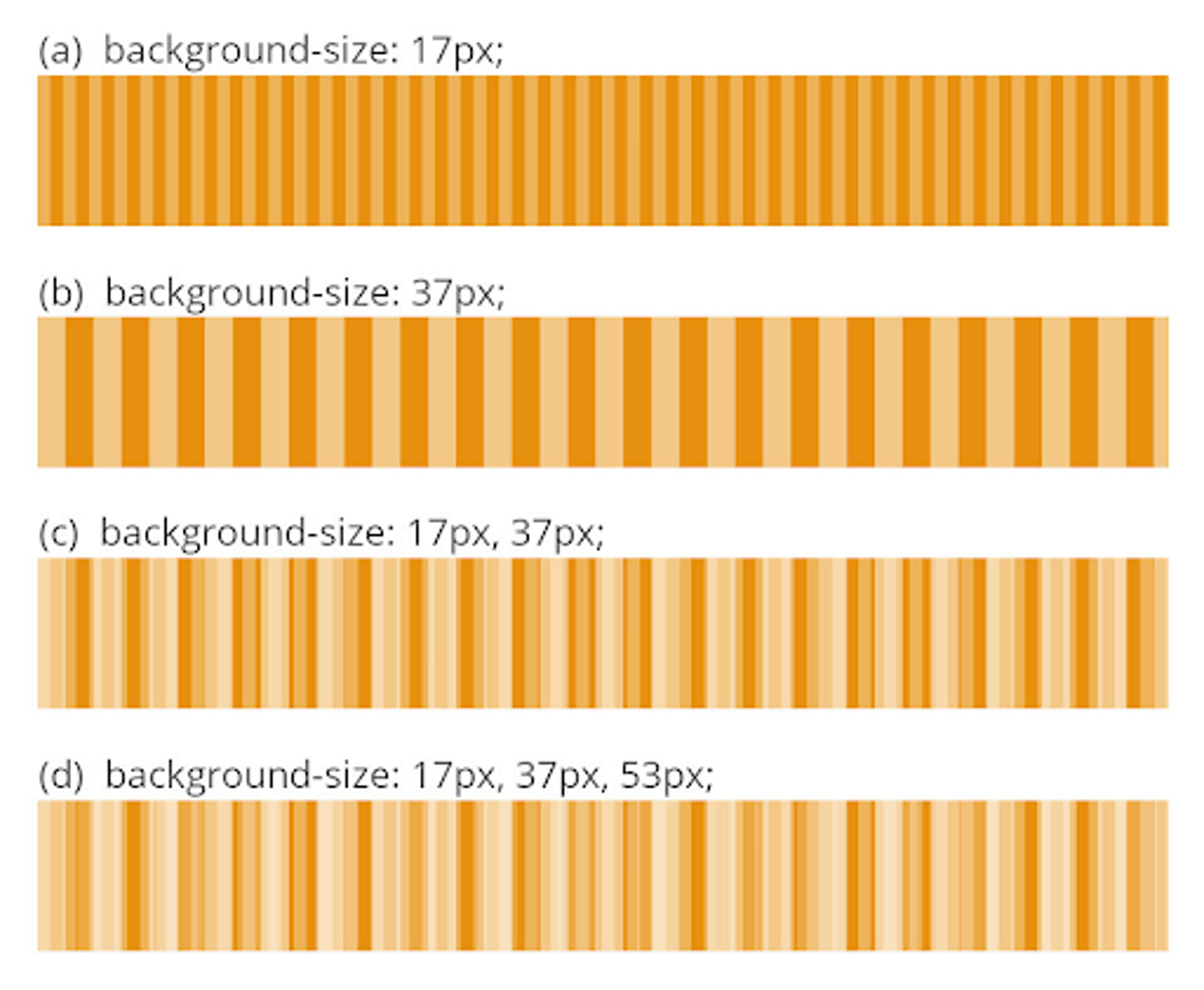
Web designers face a perpetual challenge: creating rich, non-repeating textures without enormous file sizes. The solution? Multiple texture layers that repeat at prime dimensions.
If you create three layers with dimensions 29 pixels, 37 pixels, and 53 pixels, the combined pattern doesn't repeat until 29 × 37 × 53 = 56,869 pixels. With tiny assets (under 7KB each), you generate massive non-repeating textures. The overlapping layers create emergent colors and patterns that appear organic and random to the human eye.
Example 2: "Totally Not a Scam" Emoji Rain

For my symposium presentation, I created an animation where emojis "rain" down the screen with each visual parameter following an independent prime cycle:
- Font size changes: every 3 spans
- Horizontal drift pattern 1: every 5 spans
- Horizontal drift pattern 2: every 7 spans
- Animation delay variation: every 11 spans
Because these numbers are pairwise coprime (they share no common factors), the least common multiple is 3 × 5 × 7 × 11 = 1,155. With each span lasting approximately 6 seconds, the animation loops only once every 1,155 × 6 seconds—roughly 2 hours. To the viewer, it appears endlessly varied and natural, never obviously repeating.
THE SAME PRINCIPLE IN PSEUDORANDOM NUMBER GENERATION
The identical logic appears in mathematics when generating pseudorandom numbers. Consider the classic linear congruential generator (with c = 0):
xₙ₊₁ = (a × xₙ) mod p
When p is prime, and a is a primitive root modulo p, the sequence has maximal period p − 1.
The key observation: this produces a sequence with long repetition time, locally random behavior, and minimal alignment with other cycles. These are precisely the cicada's three properties, but formalized through modular arithmetic.
BEYOND THE SEVEN MINUTES: ENTOMOLOGY TO CRYPTOGRAPHY
The same principle that helps cicadas survive predation underlies diverse technological applications. From entomology to web design to cryptography, the pattern recurs: prime periodicity generates sequences that appear random, resist synchronization with other patterns, and repeat only over enormous timescales.
This evolutionary biological strategy reappears in mathematics as a method to generate numbers that look random. Bank ID systems, cryptographic protocols, and secure communication channels all leverage the difficulty of factoring large primes and the computational equivalent of a predator trying to synchronize with a 17-year cicada brood.
CONCLUSION
Returning to where we began: why do mathematical objects seem to describe reality so well? The answer lies in structural thinking. Rather than viewing mathematics as a collection of abstract objects, we should view it as a set of patterns and structures. These structures—Euclidean spaces, topological spaces, algebraic groups—are collections of objects with common underlying rules (axioms and theorems) that bind them together.
The crucial insight from structuralism is that objects themselves are defined by the structures they inhabit. An equilateral triangle means one thing in Euclidean geometry and something more specific within the structure of triangles alone. The structure defines the object, not the reverse.
When we observe cicadas employing prime-number periodicity, we're not witnessing mathematics "in" nature. Rather, we're recognizing that the underlying structure of prime number theory provides a framework that explains the evolutionary phenomenon. Mathematics doesn't demonstrate the actual evolutionary process; it rationalizes and justifies the existence of the observed pattern. This is why the same mathematical principle can illuminate evolutionary biology, web design, and cryptography simultaneously. The structure persists across domains; only the physical manifestation changes.
Simple mathematical ideas connect seemingly distant fields and lead to wide-ranging applications. The cicada's prime-number life cycle, the web designer's non-repeating texture, and the cryptographer's secure random number generator all draw from the same well: the structural properties of prime numbers.
After all, any creature that has spent millions of years perfecting the art of unpredictability through mathematical elegance surely has lessons to teach us about security, randomness, and the deep structures underlying both nature and computation.


